Digital Markets Act: How a clever maneuver allows Apple to circumvent new regulations?
Greg Taieb · · 4 min read
The iPhone app ecosystem is undergoing its biggest transformation since 2008, following Apple's response to the EU DMA.
Have a coffee, I'll explain everything.
Reminder what is the DMA?
The Digital Markets Act (DMA) is a European law designed to limit the power of the "gatekeepers" of the digital economy, such as Apple. It aims to create a more equitable and secure Internet, stimulate innovation and offer consumers more choice, better services and fairer prices
What impacts for Apple?
Apple announced changes to iOS, Safari and the App Store to comply with the DMA. These changes include more than 600 new APIs, expanded functionality for alternative browser engines, and options for processing app payments and distributing iOS apps March, with iOS 17.4, European users will be able to download apps from marketplaces other than the Apple App Store, after approval by Apple. from Apple or integrate a third-party system, at no additional cost.
💰 Reduced Commission:
Apps using alternative payment systems will pay a commission of 17% instead of 30%, with an even lower rate for small businesses. If they choose to stay with Apple's payment system, they will incur an additional 3% processing fee.
🌍 Additional Openings:
Apple allows alternative browser engines and launches game streaming services globally.
Why does Apple's response pose a problem?
Apple's announcement of its strategy to comply with the DMA did not fail to provoke a reaction.
But this announcement sparked strong criticism, notably from Daniel Ek of Spotify. According to him, Apple would be playing a fool's game, proposing solutions which would complicate rather than resolve the monopoly problems.
It is in particular the arrival of a new commission which poses a problem.
🎵 The Spotify Case: Spotify, this streaming music giant, impatiently awaited the application of the DMA, seeing in it a powerful bulwark against what it perceives as an abusive monopoly of the Apple App Store. But, according to Ek, Apple would have concocted a response full of tricks and detours to circumvent the spirit of this law. It paints a picture where Apple, instead of adapting and innovating, indulges in delaying strategies, going so far as to implement a complex and potentially more expensive pricing system for apps like WhatsApp, Duolingo, and others. The accusation is heavy: Apple would seek not only to maintain its hold, but also to discourage any attempt at competition.
Let's see this in detail...
The "Core Technology Fee" (CTF) is a new commission introduced by Apple for developers of iOS applications in the European Union. This €0.50 commission applies to each first annual installation of an application beyond one million installations in the last 12 months. Developers can choose to stay with the current App Store commercial terms (i.e. only distribute their app on the Appstore) or adopt the new terms.
Problem: The developer of a popular free application who chooses to market it on an alternative store would have to pay a considerable sum to Apple beyond the million installs.
A fee calculator is available to help developers estimate the financial impact of these new conditions
Example: a developer whose free application is downloaded 2 million times/year and who wishes to distribute this app on an alternative store would have to pay $45,000/month.
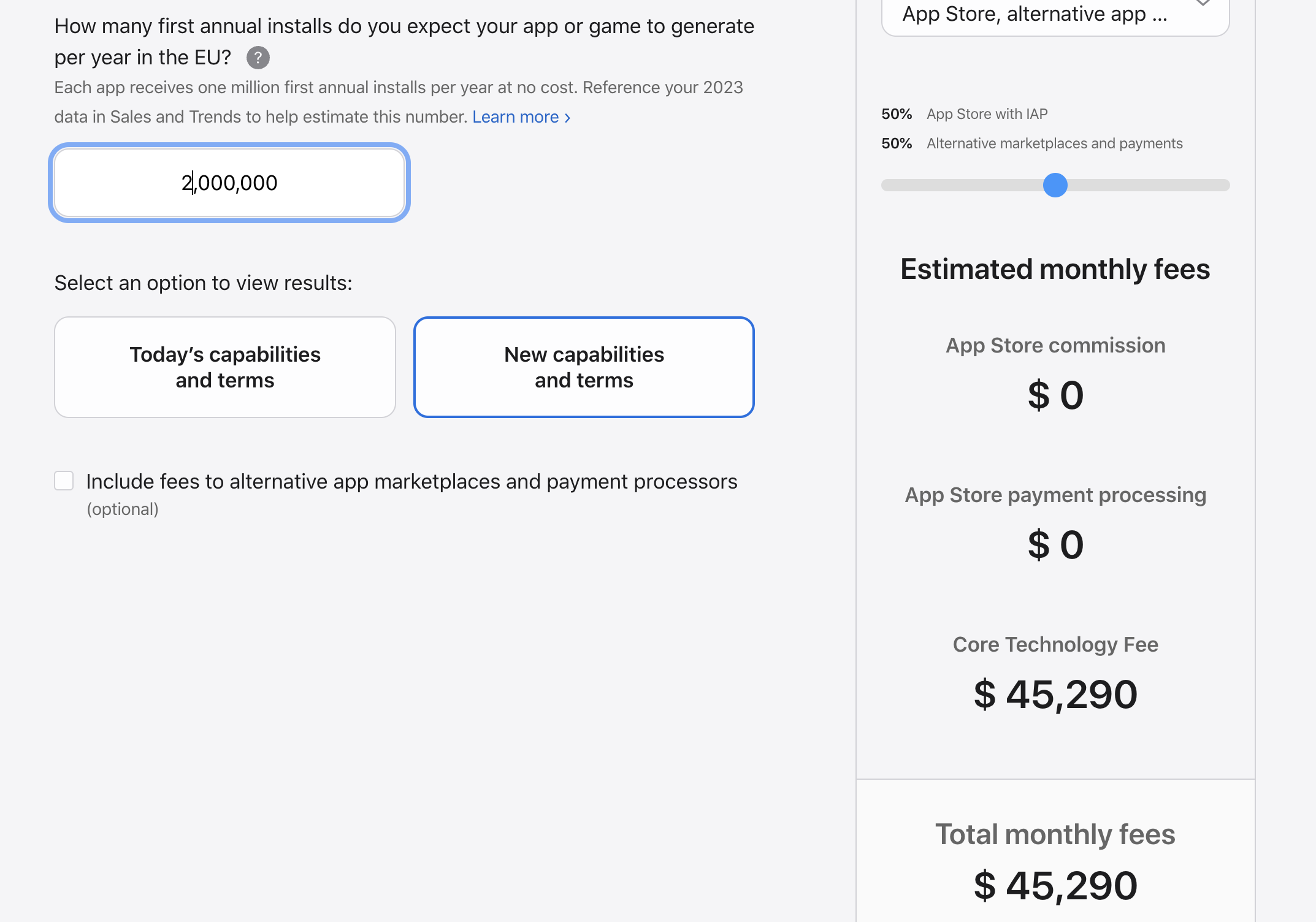
No third-party developer could support this financially and even for more solid companies like Spotify this will result in costs running into the millions!
Result: Apple complies with the DMA by offering application installation via alternative stores but makes the situation untenable for developers who are likely to stay with Apple so as not to have to pay astronomical fees.
In conclusion
In conclusion, Apple's approach to the DMA raises important questions about the balance between regulatory compliance and maintaining its business model.
Although the announced changes appear to meet the requirements of the DMA, the implementation of the Core Technology Fee (CTF) risks limiting the attractiveness of third-party App Stores for developers. This strategy could potentially restrict competition, contrary to the spirit of the DMA to foster a more open and fair digital market.
The future will tell us whether EU regulators will intervene to adjust these measures and whether the European digital ecosystem will see a real diversification of its application platforms.