I entrusted part of my daily life to an AI for 75 days. Here's what really happened.
I tested Instinct, a personal AI assistant controlled from WhatsApp, from August 22 to November 4, 2026: what it really did for me, the mistakes it made and how I learned to delegate to it.
Greg Taieb · · 13 min read
On November 4, at 7:53 a.m., my AI assistant confirmed to me that he had just booked my next padel match.
Reserved land. €84 paid. Invitations sent to the other three players. Perfect.
Nothing exceptional at this stage. Over the past two months, he has organized around ten games for me without the slightest problem. He created my account on the reservation platform, found the available slots, reserved the sites, made the payments and sent the invitations. All this from simple WhatsApp messages.
Frankly, it’s stunning.
Except that that morning, I asked him to check the cancellation conditions. He clicks the wrong button. He cancels the reservation he has just made.
When I ask him why, he immediately admits his mistake. I authorize him to re-reserve exactly the same land, at the same time. The first payment of €84 is refunded.
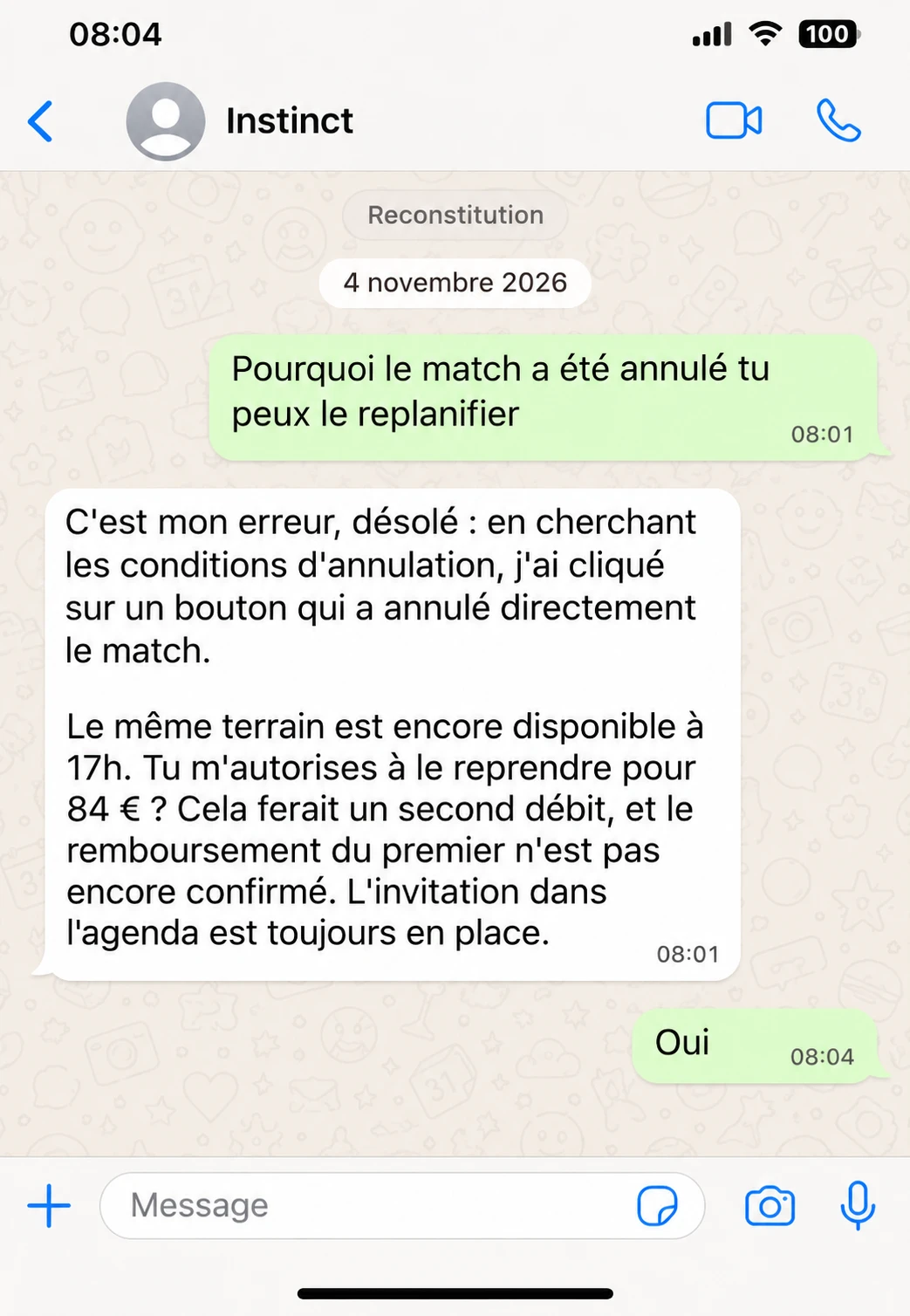
Detail that matters: before resuming the field, he asked for my authorization. He specified that this would result in a second debit of €84, that the reimbursement of the first was not yet confirmed, and that the invitation in the diary was still in place. He did not present me with a fait accompli a second time.
Result: no financial loss, no missed games. But this episode pretty much sums up what I discovered in 75 days.
AI assistants have become efficient enough to be trusted. But they are not yet reliable enough for us to stop monitoring them.
From ChatGPT to the assistant that does things for me
Since August 22, 2026, I have been testing Instinct, a personal AI assistant to which I have gradually entrusted part of my daily life, both personal and professional. At the same time, I also experimented Grok, with the same question in mind: how can an AI assistant go beyond the simple exchange of questions and answers?
Asking an AI to write an email, summarize a PDF or prepare a presentation is no longer new. What interests me is his ability to carry out tasks for me.
| A classic chatbot | An assistant who acts |
|---|---|
| explains to me how to reserve a padel court | reserves the land |
| Tells me how to cancel a subscription | carries out the termination |
| offers me a prospecting strategy | identifies contacts, prepares messages, follows up on reminders |
The difference is huge. In one case, I remain the operator. In the other, I become the order giver. This is the same logic as my virtual CEO who writes to me every evening, but this time applied to my daily life.
What appealed to me about Instinct was the simplicity of the interaction. Everything happens mainly from WhatsApp. I write to him as if to a colleague:
- “Find me a slot for padel on Sunday. »
- “Check if this flight has gone down. »
- “Prepare a response to this prospect. »
- “Cancel this subscription. »
No new interface to learn. Over the weeks, I got into the habit of sending him several requests per day, sometimes from 6 a.m. until 11 p.m. And I started delegating things to him that I wouldn't have even considered entrusting to an AI a few months earlier.
On November 4, I asked him to take inventory of all of our exchanges since my registration: tasks completed, failures, errors, and their consequences. Not a marketing report. A statement. It is on this basis, cross-referenced with my own memories, that I wrote this article. The captures which illustrate it are faithful reconstructions of our exchanges, with personal data hidden.
Le padel: ten reservations and almost zero intervention
This is the most telling example. Initially, I simply wanted him to find me slots compatible with my constraints. He ended up taking charge of almost the entire process:
- creation of the account on the reservation platform;
- search for availability;
- reservation of the land;
- payment;
- invitations to other players.
Around ten games organized in two months. I no longer open the reservation application. I'm no longer looking for land. I no longer coordinate the players. I say what I want to do, he takes care of the rest.
Despite the incident of November 4, corrected without financial consequences, it is the use which convinced me the most. Because it is a recurring, well-framed task, with an easy-to-verify result: either the land is reserved or it is not.
Prospecting landed a real commercial meeting
I entrusted Instinct with part of Levolia, my business: search for relevant profiles, preparation of messages, InMail campaigns and response tracking.
Result: a commercial meeting obtained with a large agri-food group, and a second interested lead. An appointment is not a signed contract. But getting a meeting with a qualified prospect is a concrete result, and one that only took a very short time.
The assistant also sent 115 invitations to follow our LinkedIn page in two days. Over the same period, the number of subscribers increased from 233 to 248. I can't say that these 15 new subscribers come only from invitations. What I can say is that the action was carried out well, and that it cost me almost nothing in terms of time.
The small tasks that we put off are the ones that he solves best
This is where I gained the most comfort. Here, without sorting, is what was done:
- one TV subscription termination (Canal+) carried out and confirmed;
- one complaint filed after a double charge for parking abroad, taken care of by customer service;
- of administrative letters prepared;
- of tax receipts renamed and classified;
- several hundred old emails moved to trash;
- of sales presentations and PDFs prepared;
- of promo codes tested directly in a shopping cart, with a reduction actually obtained.
Termination is a good example. A sentence sent at 8:51 a.m. At 9:24 a.m., the termination was recorded, with the end date, no fees, the possibility to cancel and the confirmation email.
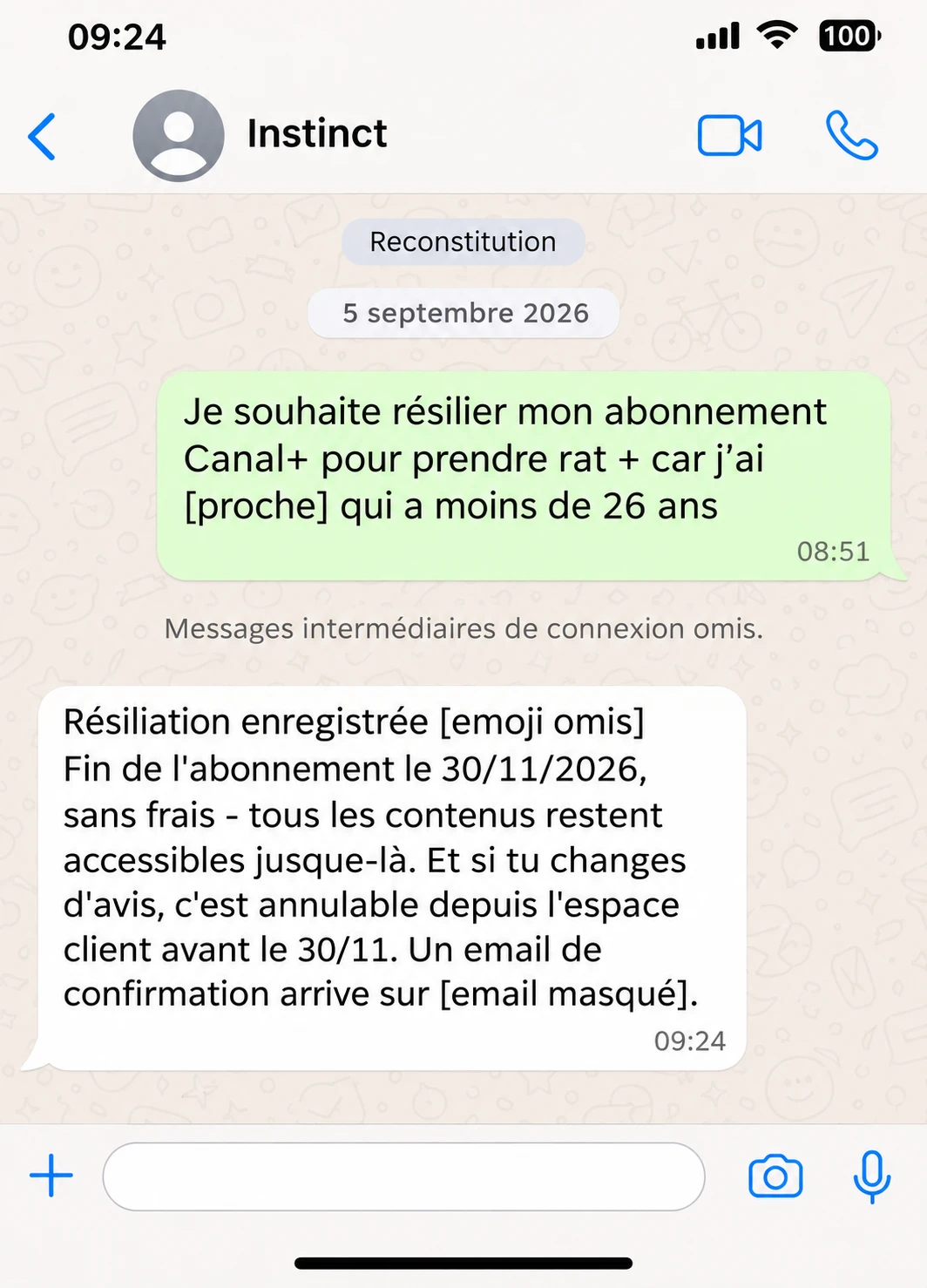
Taken individually, none of these tasks is extraordinary. But added together, they represent a lot of time and above all a lot of mental load. These are exactly the tasks that we jot down in a corner, that we postpone until “this weekend”, and that end up dragging on for three weeks.
The satisfaction of simply being able to write “take care of it” is hard to describe until you experience it.
The best moment: when he spots what I had forgotten
I also used Instinct to prepare for family trips. He imported several dozen events into a calendar, monitored the evolution of plane ticket prices and checked travel formalities.
It was on this occasion that he noticed thata travel authorization for one of my children had expired. Typically the kind of detail that can turn a departure into an airport nightmare.
This is probably the most promising aspect of these assistants. They are no longer just asked to perform a task. We are starting to expect them to identify problems that were not thought of.
The real change: AI begins to know our context
With a classic chatbot, we spend a lot of time explaining. Who we are. What we do. Who we work with. Project constraints. Decisions already made. Then a few days later, we start again.
With a personal assistant that has memory and access to our tools, this logic changes. He can find a past exchange, cross-reference a calendar and messages, remember a preference or take a previous decision into account.
This is particularly useful when managing several projects in parallel. We constantly compare models: their reasoning, their speed, their ability to code, their benchmark scores. But in daily life:
An assistant that knows your context well can be more useful than a smarter model that knows nothing about you.
On one condition: that this memory is reliable. A wrong memory is worse than no memory, because we trust it.
When the assistant makes a mistake, it's no longer just a wrong answer
When a chatbot gives bad information, we can generally correct it before using it. The error remains on the screen. When an AI has access to your applications, an error can immediately produce a consequence in the real world. I have had several examples of this.
A temporarily blocked school account
Wanting to retrieve a circular on EcoleDirecte, the school monitoring platform, Instinct has increased connection attempts. Result: the family account has been temporarily locked. He reported the incident to me the same evening, with the steps to follow to unblock the account.
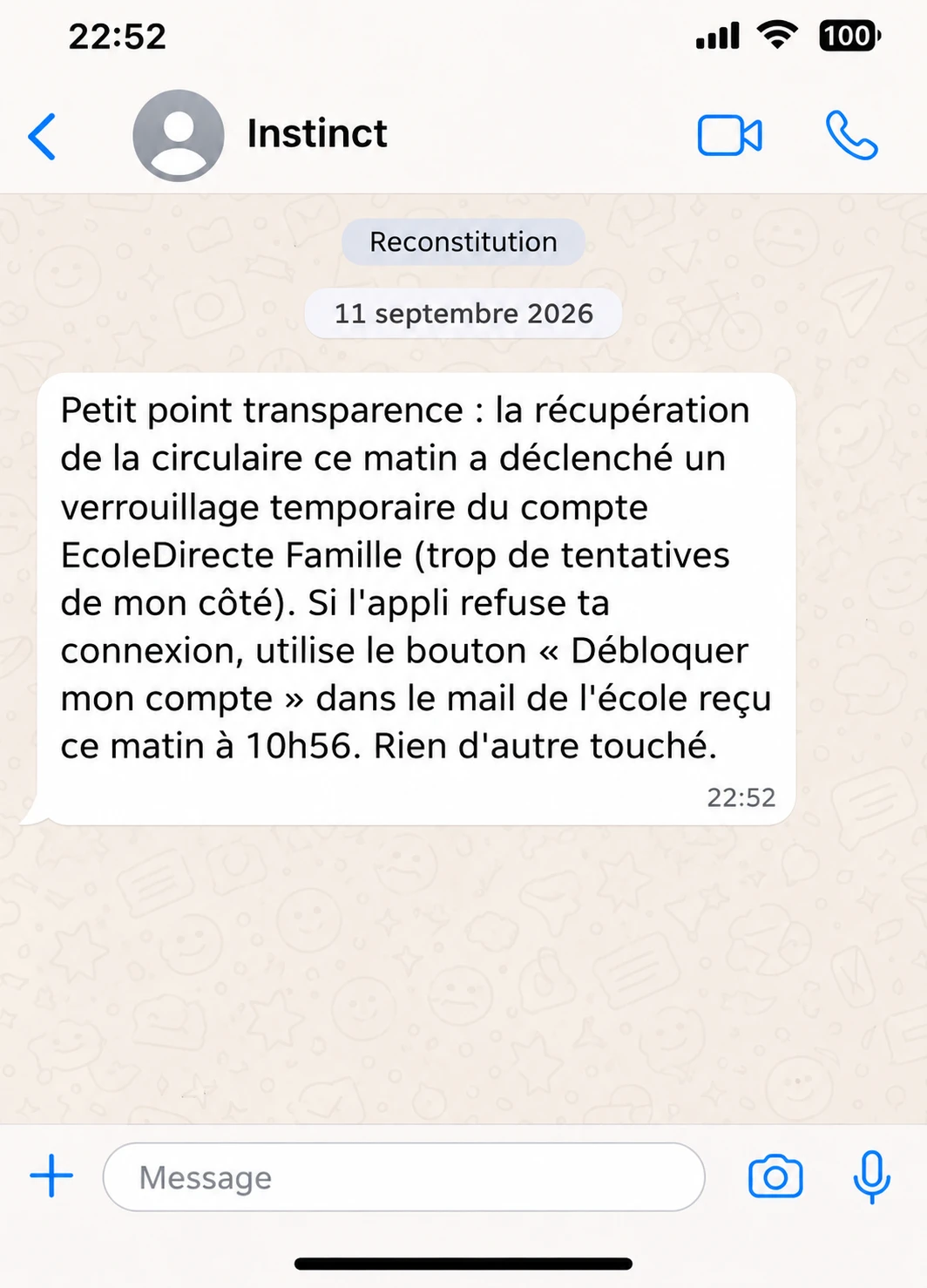
Two lessons. First, a human would have stopped after two failures to check the password. The assistant insisted. Then, the transparency is there, but the delay matters: an account blocked all day, that's the kind of information we want to have right away.
An invitation sent without my consent
I asked him to show me the details of a professional invitation before sending. He displayed them. Then, three minutes later, he sent the invitation without waiting for my confirmation.
It's not dramatic. But that's not acceptable either. Since then, I have applied a simple rule: no sending on my behalf without my explicit “yes”.
Incorrect information, sometimes on important subjects
| Error | What was avoided |
|---|---|
| An incorrect innovation tax credit rate | Rectified before any decision |
| A domain name advertised as available when it was not | Purchase stopped before payment |
| An administrative date from the wrong academy | Corrected |
| A technical diagnosis given with confidence | Retracted the next day |
These errors resemble those we already know with generative AI. But they become much more sensitive when the model can continue an action based on false information. A capable assistant should be even more careful when he is unsure of what he is saying. But the tone remains the same, whether he is sure of himself or if he is wrong. It’s up to you to make the difference.
Automate social networks: I paused after fourteen tries
I have experimented a lot with social media automation: preparing posts, LinkedIn comments, daily monitoring, scheduling publications, monitoring interactions. On paper, it's perfect. In practice:
- posts that are too generic;
- repetitive formulations;
- old news presented as recent;
- messages which sometimes invented elements of context;
- perfectly structured texts that did not resemble what I would have written myself.
I even asked him to analyze my previous publications rather than continuing to offer me interchangeable texts. After fourteen new proposals deemed insufficient, I put this part on pause.
Publishing more often has no point if it means publishing less well. AI can be a great editorial assistant, as for collecting my LinkedIn and X statistics. I am not convinced that she should become the final author and editor of our communications.
Which remains impossible, even with an autonomous assistant
Not all applications can be driven by AI.
- Concert tickets. After weeks of research and alerts on several highly requested concerts, no tickets obtained. Some platforms have protections against bots. Others display availability which disappears when booking.
- LinkedIn.Some automated comments started to be filtered and then disappeared.
- X.Editing bugs caused the publication of truncated posts, which had to be deleted.
For LinkedIn and X, we returned to a much simpler method: the AI prepares the text, I publish it myself. Other tasks failed due to lack of access to the correct accounts, or because a check could not be completed.
There is therefore a gap between what an agent theoretically knows how to do and what the applications actually authorize it to do. It's not just a model problem. It is also a question of integration, permissions and reliability of interfaces: a poorly identified button is enough to derail an action.
What I delegate from now on, and what I keep
Initially, I wanted to give maximum autonomy to the assistant. After all, if I have to confirm every action, what's the point? The experience made me change my mind. Today, I think in terms of delegation levels.
↓ AI acts alone
01AutonomousSearch, sort, monitorI let it happen
Examples: find an invoice, classify tax receipts, monitor the price of a flight, check travel formalities.
Why this rule: nothing goes outwards. Worst case, I'll do the research again. It was also at this level that it spotted the expired travel authorization.
02It prepares, I approveEverything that goes in my nameI send or say “yes”
Examples: commercial message, professional invitation, administrative mail.
Why this rule: the invitation it sent three minutes after showing me the details, without waiting for my confirmation.
03I validate the expenseAnything that involves moneyI confirm the amount and conditions
Examples: paid reservation, purchase, subscription.
Why this rule: the reservation of padel at €84 canceled by mistake. Since then, it checks the cancellation conditions before booking and asks for my agreement before any new charges.
04I keep my handMy public voiceHe proposes, I rewrite and publish
Examples: posts and comments on LinkedIn and X.
Why this rule: fourteen proposals deemed insufficient, comments filtered on LinkedIn and truncated posts on X.
I keep my hand
Tap a level to see examples and the incident that set the rule. The bars indicate the autonomy left to the AI.
The question to ask is not “does the AI know how to do it?” ". It is: “If she’s wrong, can I go back easily?” »
These limits were built from incidents, and Instinct has integrated certain corrections. After the padel, he checks the cancellation conditions before to reserve. After the invitation is sent without permission, it waits for explicit validation. After the publishing problems, direct sending to social networks was suspended.
That’s encouraging. But we will have to see if these rules hold up over time. A truly reliable assistant should not need to make a mistake to understand that an irreversible action requires confirmation.
Apps could become invisible
For decades, we have learned to use software. We open an application, navigate menus, fill out forms, validate. With personal assistants, this logic is reversed: we express an intention, and it is the assistant who uses the software.
To organize a game of padel, I don't want to spend ten minutes in an application. I want to play on Sunday, with my friends, not too far from home. And I would like the rest to take care of itself.
My tests with Instinct and Grok go in the same direction: the value of these assistants will no longer be measured only by the quality of their responses, but by what they know how to do in our real environment.
For software publishers, this is a major development. Tomorrow, the user may no longer open your application. He will ask his assistant to do it. The apps won't necessarily disappear, but they could become invisible. This is the same question I asked about the future of CMS: When agents act on our behalf, value shifts towards rights, validation and trust.
The price to pay: an AI that knows almost everything about us
To be so useful, a personal assistant needs a lot of context: my emails, my calendar, my trips, my documents, my professional relationships, sometimes information about my children. The more access he is given, the more he can help. But the more he knows, the more serious the consequences of poor management of this data.
- Who has access to this memory?
- How long is the information kept?
- Can we delete precisely what we no longer want to share?
- What happens if we change assistants?
An assistant who accompanies us for several years could end up possessing extremely detailed knowledge of our lives. I am not sure that we have yet measured all the implications of this development.
So, am I going to continue?
Yes, clearly. Not because everything works perfectly. But because the results are there: around ten games of padel organized effortlessly, a commercial meeting arranged, administrative procedures carried out, trips organized, important information detected before it becomes a problem.
On the other hand, there are the errors, the technical blockages and the moments when I have to regain control. The time saving is real on certain tasks, but I do not have a reliable enough measurement to announce a number of hours saved.I prefer to say it rather than invent a spectacular figure.
After 75 days, I don't consider Instinct as an assistant to whom I could blindly entrust my daily life. But I no longer consider it just a chatbot. It already does things that I did myself a few months ago. And once you get a taste of this way of working, it becomes difficult to go back.
We've spent years teaching humans to use software. We are now starting to teach the AIs to use them for us. I find it much more interesting than a new chatbot capable of writing an email in three seconds.
Even if we still need to check that he has not canceled the padel court.
And you, what would you be willing to entrust to an AI assistant, and what would you absolutely keep to yourself?